The Myth of the Self-Sufficient Man in Ministry

Let’s name it…
There is a myth that moves quietly through ministry culture. It rarely shows up in sermons, and you will not find it in any doctrinal statement. Yet it forms expectations all the same. It whispers that strong men absorb pressure without asking for help. It suggests that faithful leaders carry the weight without complaint. It implies that maturity looks like quiet endurance.
Many men in ministry live inside this story without realizing it.
The myth feels noble because it sounds like strength. A man who works hard, provides faithfully, preaches boldly, and carries the emotional burdens of others without wavering earns respect. Congregations feel steady when their pastor seems unshakeable. Boards feel secure when their executive leader absorbs tension without visible strain. Families often learn to orbit around a man who carries so much for everyone else.
Then transition arrives.
It may come through resignation, burnout, board conflict, or a season of redirection that feels both right and terrifying. It may come suddenly or after years of slow erosion. When it does, the myth of self-sufficiency begins to collapse. The man who once felt central now feels exposed. The steady voice now feels uncertain. The identity that felt solid begins to wobble.
What remains is often isolation, shame, and fear.
We have discipled men to preach grace while quietly living alone.
Have we forgotten loneliness in the garden?
In Genesis 2:18, God declares, “It is not good that the man should be alone.” That verse is frequently used in wedding ceremonies, and rightly so. Yet before it speaks to marriage, it reveals something deeper about design. The problem in the garden was not sin. It was solitude.
Before the fall, before shame, before conflict, there was one condition that God named as not good. Man alone.
That statement reaches far beyond romantic partnership. It speaks to the architecture of the human soul. Men were created to cultivate, guard, build, and flourish in relationship. The image of God is communal. Father, Son, and Spirit exist in eternal fellowship. Creation itself emerges from shared delight.
Isolation was never part of the design.
Ecclesiastes 4:9–10 reinforces this reality with clarity and urgency: “Two are better than one… For if they fall, one will lift up his fellow. But woe to him who is alone when he falls and has not another to lift him up.” The writer assumes that falling will happen. The issue is not whether men stumble. The issue is whether anyone stands nearby to help them rise.
Ministry transition feels like a fall.
It may not involve moral failure or public scandal. It may arise from faithful obedience. Even so, it destabilizes. It disrupts routines. It challenges identity. It unsettles provision. It exposes insecurity. The man who once stood at the center now feels unmoored.
And too many men fall without another close enough to lift them.
The uniqueness of transition for men
For many men, identity and provision are intertwined at a deep level. Scripture affirms the weight of responsibility. In 1 Timothy 5:8, Paul speaks clearly about the seriousness of providing for one’s household. Men often internalize provision as more than duty. It becomes evidence of worth.
When transition shifts income, title, or platform, the internal tremor runs deep. The questions surface quickly and quietly. Who am I if I am not leading? Who am I if my influence shrinks? What does this say about my competence? What does it say about my faith?
These questions often remain unspoken.
Without trusted brothers to help interpret what is happening, the internal narrative grows louder. The imagination fills in worst-case scenarios. Insecurity takes root. A man who once counseled others now struggles to counsel himself.
Isolation amplifies the voice of accusation. Silence intensifies shame.
Destructive defaults
When pressure builds and no safe space exists to process it, many men reach for relief. The behaviors vary. Some immerse themselves in work to prove value. Some drift toward pornography in search of escape. Some numb themselves with alcohol. Others retreat emotionally from family and friends. These patterns do not begin as grand rebellion. They begin as attempts to regulate overwhelming stress.
James 1:14–15 describes the progression of desire in stark language. Desire conceives. Sin grows. The outcome matures into death. The passage describes a process that feels slow and almost invisible at first. What begins as comfort becomes control. What begins as coping becomes allegiance.
Whatever masters a man shapes him.
Shame then locks the door from the inside. A leader who feels responsible for guiding others struggles to admit he needs help himself. The myth of self-sufficiency tightens its grip. The appearance of strength becomes more important than the reality of health.
The enemy understands this dynamic well. A public fall is visible. A private isolation can last for years.
The Lie of Emotional Illiteracy
Many men struggle to articulate what they feel during transition. This does not mean they lack emotion. It means they lack language. Few men were trained to identify anxiety, grief, disappointment, or fear with precision. As a result, complex internal experiences surface in blunt ways.
Anxiety often emerges as anger. Grief appears as withdrawal. Fear manifests as control. Sadness disguises itself as irritability.
What looks like strength on the outside can actually be emotional confusion on the inside. A man who once preached with clarity may feel a fog he cannot name. A leader who once made decisive calls may hesitate and then overcorrect. The internal landscape shifts, yet without vocabulary, he cannot map it.
When men lack emotional language, they default to action instead of reflection. They fix something. They build something. They confront someone. They move faster. Movement feels productive. Reflection feels exposed. Yet unexamined emotion does not disappear. It migrates. It shows up in tone. It shows up in impatience. It shows up in strained relationships.
Scripture never treats emotional awareness as weakness. The Psalms are filled with emotional specificity. David names fear, rage, despair, confusion, and hope. He does not collapse into them, yet he does not deny them either. “Why are you cast down, O my soul?” he asks in Psalm 42. That question alone reveals a man willing to examine his interior life.
Jesus Himself demonstrates emotional clarity. In the Garden of Gethsemane, He tells His closest friends, “My soul is very sorrowful, even to death.” He names sorrow. He names distress. He invites others into it. Emotional awareness does not diminish His strength. It reveals His humanity.
When leaders bypass this kind of interior honesty, coping mechanisms step in where understanding is absent. Coping may quiet symptoms temporarily, yet it rarely produces healing. A man may convince himself that staying busy proves resilience. He may tell himself that pushing forward demonstrates faith. In reality, forward motion without reflection can harden the heart.
Emotional maturity is not indulgence. It is stewardship. Proverbs 4:23 instructs, “Keep your heart with all vigilance, for from it flow the springs of life.” The heart directs behavior, tone, decision-making, and leadership presence. Guarding it requires awareness. Awareness requires language. Language often requires community.
When another man sits across the table and asks, “What are you actually feeling right now?” something sacred happens. Fog begins to lift. The vague becomes specific. The unnamed becomes manageable. Shame loosens its grip when experience is brought into the light.
Transition magnifies whatever has been unaddressed in the heart. If emotional awareness has been neglected for years, transition exposes that gap quickly. If emotional stewardship has been practiced in community, transition becomes an arena for growth rather than collapse.
Emotional literacy does not make a man soft. It makes him stable. It allows him to respond rather than react. It enables him to lead his family and organization from clarity instead of confusion. It turns transition into refinement instead of rupture.
A man who can name what he feels is far less likely to be mastered by it.
Brotherhood as formation
Proverbs 27:17 states, “Iron sharpens iron, and one man sharpens another.” Sharpening implies friction. It requires contact, proximity, and intentionality. Formation does not happen through occasional encouragement alone. It takes presence.
Jesus modeled this pattern. He did not carry out His ministry in isolation. He gathered twelve men. Within that group, He invested deeply in three. He invited them into His prayers, His grief, and even His anguish in Gethsemane. The Son of God chose proximity.
Brotherhood is not sentimental. It is transformational.
Men often bond shoulder to shoulder before they connect face to face. Shared mission builds trust. Shared challenge cultivates respect. Shared struggle opens vulnerability. When a man names a courage goal and other men walk beside him, something shifts internally. He experiences reinforcement rather than critique. He receives strength rather than shame.
Transition becomes a refining process instead of a solitary descent.
The ripple effect of isolation
Isolation feels manageable in the short term. A man convinces himself that protecting others from his struggle is an act of love. He absorbs stress quietly. He shields his family from his fear. He keeps his board at arm’s length. He believes containment equals control.
Over time, unprocessed pressure leaks.
Marriages absorb tension. Children sense emotional distance. Staff notice irritability. Congregations feel instability in subtle ways. The interior life of a leader always influences the external environment.
Isolation rarely remains isolated.
When one man walks alone, the ripple spreads through every relationship connected to him.
A different vision for transitions
Imagine another path.
A leader senses that change is approaching. Before announcements are drafted and strategies are outlined, he gathers two or three trusted men. He speaks plainly about his fears. He confesses anxiety about provision. He admits temptation toward unhealthy coping. He invites prayer and honest counsel.
Those men remind him of his identity apart from his title. They challenge him toward courage. They sit with him in uncertainty.
The transition still unfolds. It still carries difficulty. Yet the process becomes formative rather than destructive. The man emerges refined instead of diminished.
This vision is attainable. It requires intentionality.
For boards and decision-makers, the responsibility is clear. Leadership transition is not merely organizational adjustment. It is personal stewardship. When guiding someone through change, the question must extend beyond logistics.
Who is holding this leader up emotionally and spiritually? Providing counseling, coaching, and brotherhood during transition shapes outcomes more than severance packages or press releases ever will. Care protects people. Care preserves purpose.
Let’s be men of courage
If you are a man in ministry, begin building brotherhood before transition arrives. Cultivate relationships rooted in honesty and challenge. Invest in spaces where strength and vulnerability coexist. If you are navigating change now, resist the impulse to withdraw. Invite others into your process. Name your fear. Seek counsel early. If you are responsible for leading others through transition, shape cultures where men are strengthened through connection rather than admired for isolation.
The gospel proclaims restoration. Restoration flourishes in community. The cross reconciles us to God and to one another. Leadership formed in that reality reflects humility, courage, and shared strength.
Self-sufficiency sounds strong. Brotherhood builds endurance.
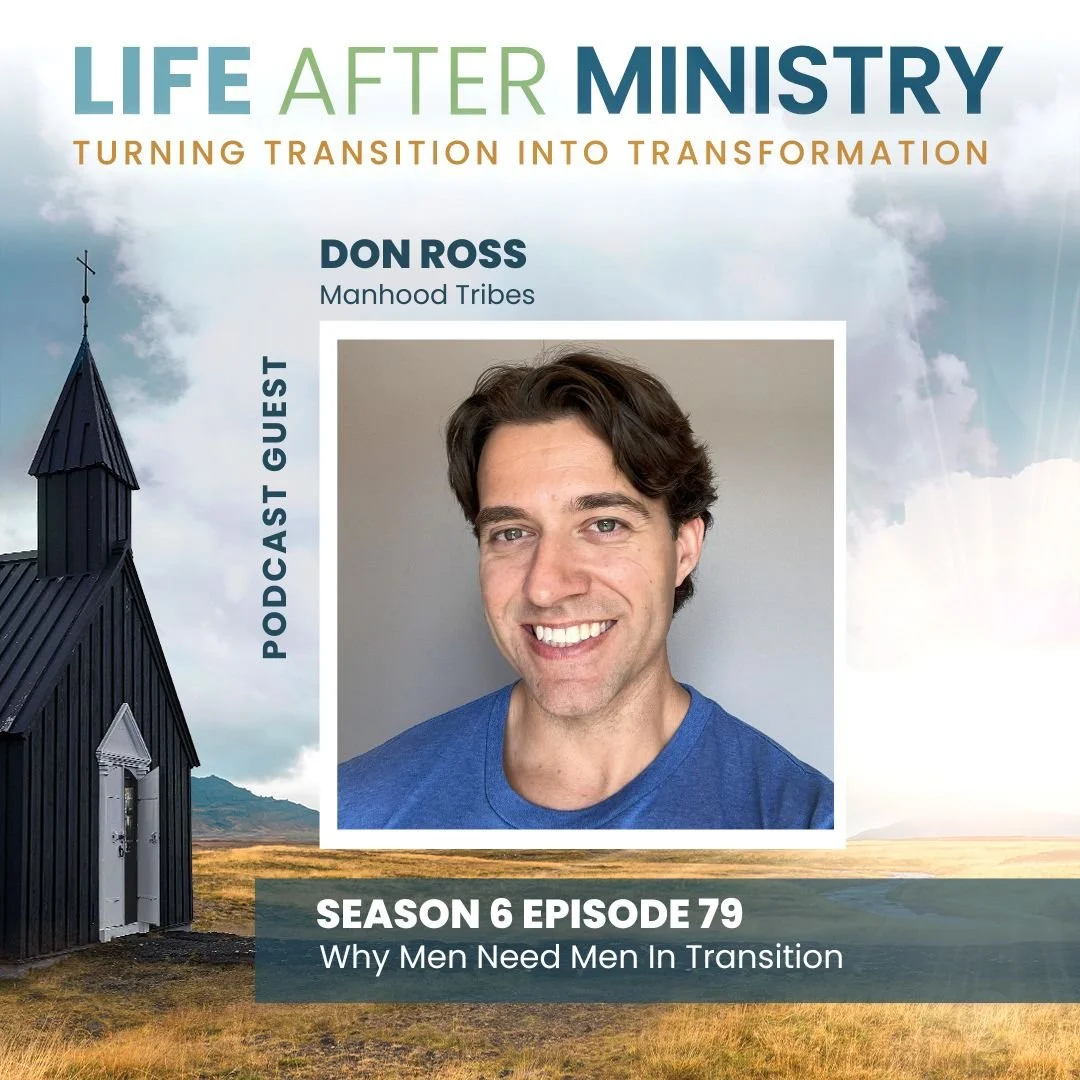
And in seasons of transition, endurance rooted in community becomes the difference between quiet collapse and steady renewal. If this resonates, continue the conversation through our recent Life After Ministry episode with Don Ross of Manhood Tribes exploring brotherhood and transition in greater depth.

Matt Davis served as a Teaching and Executive Pastor for more than two decades in Orange County, California. After going through his own pastoral transition out of ministry, Matt learned the difficulty of this season. He helped start Ministry Transitions, a ministry committed to helping ministry leaders navigate transitions with grace. As President, he seeks to bring healing a reconciliation to churches and their people.